EXPLORING MAHASTHANGAR
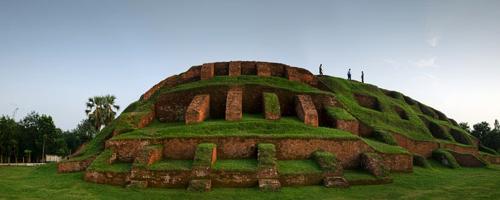
When we talk about ancient
civilizations, the Indian subcontinent is a hotspot for priceless sites of
archaeological remains. One such 2500-year-old ancient city is Pundranagar, a prosperous city of the ancient Bengal. Its ruins were found in
the Mahasthangar village of Bogra district in Bangladesh.
From DHAKA, I
reached Bogra town very early in the evening and checked into a
TMSS in Bagura.
The first day was dedicated to the wedding and the discovery of the city and its gastronomy
Mahasthangarh is one of the oldest and most traditional places among the archaeological monuments of Bangladesh. This ancient monument is located on the banks of Karatoya River in Shibganjupazila, 13 km north of Bogra district of Rajshahi division. It was part of Pundravardhana in ancient Bengal. Pundravardhan was the richest city of ancient Bengal. The capital of this Pundravardhan was Pundranagara, later known as Mahasthangarh. It was an important city of the Maurya Empire. “Mahasthan” means holy place and “garh” means fortress. This place was built around 2,500 years ago and was known for Buddhist teachings. In the past, many Buddhist monks from China and Tibet came here to study. They then spread to various countries in South and East Asia to propagate this education. Chinese traveler Hsiuen Tsang wrote about this place in his travel diary. From TMSS we took a battery-powered auto rickshaw to Matidali Point (or Biman Mor) from where we had to take a CNG auto rickshaw to reach Mohasthangar.
It was an important territory in Bengal during the reigns of the Maurya, Gupta, Pala, and Sena monarchs. It was also important under Muslim control. Unfortunately, just the ruins can be seen now. However, Mahasthangarh stands proudly. It is currently being protected by the Department of Archaeology. In 2016, it was named SAARC's cultural capital. One of the causes for the city's development is that it is one of Bangladesh's upper regions. The location is approximately 36 meters above sea level, indicating that it is naturally flood-free. A wall surrounds the Mahasthan. The fortified city contains archeological monuments from several ages. The fort is positioned in the heart of the city and appears rectangular from above. It measures 1.523 kilometers north-south and 1.371 kilometers east-west. The fort wall rises around 11 to 13 meters above the surrounding landscape.
It was an important area in Bengal during the
reigns of the Maurya, Gupta, Pala, and Sena monarchs. It was also important
under Islamic control. Unfortunately, now only the ruins can be seen. However,
Mahasthangarh stands proud. It is currently protected by the Department of
Archaeology. In 2016, it was named the Cultural Capital of SAARC. One of the
reasons for the city's development is that it is one of the highest regions of
Bangladesh. The site is located approximately 36 meters above sea level,
indicating that it is naturally free from flooding. A wall surrounds the
Mahasthan. The fortified city contains archaeological monuments from different
eras. The fortress is located in the heart of the city and appears rectangular
when viewed from above. It measures 1,523 kilometers in a north-south direction
and 1,371 kilometers in an east-west direction. The fort wall rises approximately 11 to 13 meters above the surrounding landscape.
The Bridal Chamber of Behula-Lakhindar

Basar
Ghar in Behula Laksin is an old and historical structure. It is located in
Gokul village, 10 km north of Bogra town and 2 km south of Mahasthan Garh.
Locally it is known as Behula Basar Ghar. Many people call him Laxminder Medha.
This historic place is approximately 45 feet tall. The eastern half of the
pillar has a showroom-like room with 24 corners. There is a podium with a hall of
172 sqm. During excavations in 1934-36, the foundations of a large temple or
stupa were discovered here. This foundation was built in layers in the Kuturi
architectural style.
At
Behula's house, 172 kudus were filled with earth to various heights and arranged
in descending order from bottom to top to be used as foundations for tall
temples or stupas. An important architectural feature of ancient Bangladesh was
its unique architectural style of building on parallel foundations, with
multi-level walls, raised on two levels.
The Behula-Lakshins are still absent from Bengali folklore.
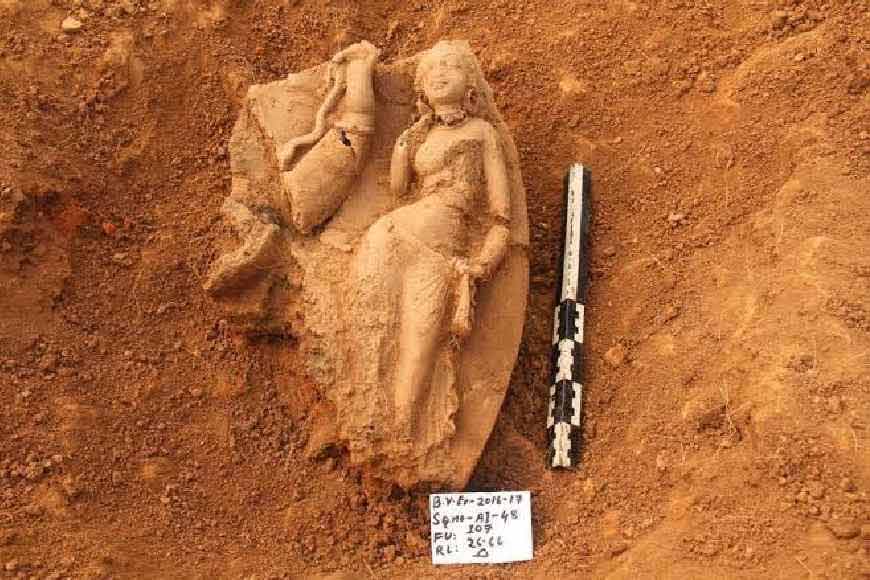
Some
terracotta plaques of the later Gupta era (600-700 century) were found with this
temple. During the Sena period (1100-1200 century) a square temple with a
verandah was built here. A small stone fragment with many holes along with a
gold leaf engraved with the portrait of a bull was found in this temple. From
this, it is assumed that it was a Shiva temple.

Popular
Songs of Manasamangal Kavya:

Then
Mansa Chand selected Saudagar and requested him to organize the Mansa Puja. However, Chand Saudagar did not agree to Mansa's proposal. Then Mansa got angry and
cursed him - every son of Chand Saudagar would die of snakebite. Thus one by one
all the sons of Chand Saudagar died of snakebite except Lakhinder under the
curse of Mansa. So at the time of Lakhinder's marriage, his father built a
house that snakes couldn't penetrate. But the snake overcame all precautions
and killed Lakhinder.
According
to the custom, the corpses of those who have been bitten by snakes are floated
on a raft in the river. Behula leaves everyone behind and sits on a raft with
her dead husband. They traveled for six months and passed village after
village. In this condition, the corpse starts to rot and the villagers consider
him mentally unstable. Still, Behula continued to pray to Mansa. Later,
Lakhinder's life was restored when Behula agreed to make her father-in-law
worship Mansa.
Comments
Post a Comment